

At a Glance: The Disaster Stats
| Metric | Details |
| :--- | :--- |
| The Founder | Soichiro Honda |
| The "Low Point" | Selling his wife's jewelry to buy food |
| The Rejections | Toyota (Job application denied) |
| The Disasters | 2 Bombings (WWII) + 1 Major Earthquake |
| The Result | The largest motorcycle manufacturer in the world |
The Hook: "You Are Not Good Enough"
In 1937, Soichiro Honda was a broke mechanic with a dream. He wanted to work for Toyota.
He spent his life savings developing a new concept for piston rings. He worked day and night, sleeping in his workshop, covered in grease. He was so poor he couldn't afford food, so he sold his wife's jewelry to keep funding his research.
Finally, he finished his prototype. He presented it to Toyota, expecting a job and a contract.
Toyota’s engineers inspected it, laughed, and rejected it. They told him it didn't meet their standards.
He was unemployed, penniless, and humiliated. Most people would have quit. Soichiro went back to school. He sat in classrooms with students half his age to learn the chemistry he was missing.
The Struggle: War and God
Two years later, he finally got the contract. He built a factory to supply Toyota. Things were looking up.
Then, the universe decided to test him.
World War II began.
- Strike 1: The government denied him concrete to build his factory. So, he invented a new way to make concrete himself.
- Strike 2: US bombers flew over Japan. His factory took a direct hit. It was burned to the ground.
- Strike 3: He rebuilt it. Then, a second air raid bombed it again.
He was standing in the ashes of his dream. The war ended, and he tried to rebuild one more time.
- Strike 4: A massive earthquake struck Japan. His newly rebuilt factory was leveled.
He had nothing left. No factory. No money. No gasoline. Japan was in ruins.
The Turning Point: The "Bata Bata"
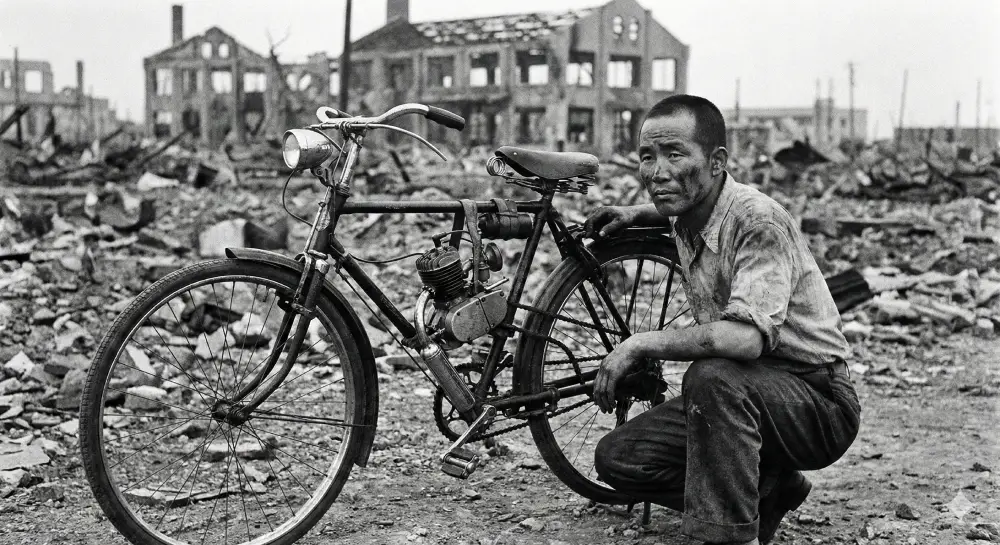
In post-war Japan, there was no public transport and no fuel. People had to walk for hours to find food.
Soichiro was sitting in his shack when he saw an old, surplus generator engine from a military radio. A lightbulb went off.
He took his wife’s bicycle and strapped the generator engine to it.
It was loud. It was dirty. It made a bata-bata sound. But it moved.
His neighbors begged him to build one for them. He ran out of engines, so he decided to build his own from scratch.
He wrote a handwritten letter to 18,000 bicycle shop owners in Japan. He pleaded: "I have an idea to get Japan moving again. Please invest in me."
3,000 of them sent him money. With that small capital, he founded the Honda Motor Company.
The Legacy: The Power of Dreams
Today, Honda is a titan of industry. But Soichiro never forgot where he came from. He was known as "Mr. Thunder" for his temper in the factory, often shouting at engineers who settled for "good enough."
He famously said:
"Success represents the 1% of your work which results from the 99% that is called failure."
3 Lessons for Founders
1. Rejection is Protection
If Toyota had hired him, Soichiro Honda would have been just another anonymous employee. Rejection forced him to build his own path. Sometimes, the door slamming in your face is the best thing that can happen to you.
2. Constraints Breed Creativity
When he couldn't get concrete, he invented his own. When he couldn't find gas, he used turpentine. When you have no resources, you are forced to be a genius.
3. Your Partner is Your Co-Founder
Honda sold his wife's jewelry to survive. Without her sacrifice and belief in his "crazy" piston rings, the company would have died in 1937. Never forget who supported you when you were nothing.
FAQ: Honda's Story
Q: Did he ever work with Toyota again?
A: Yes. Ironically, his piston ring company (Tokai Seiki) was eventually sold to Toyota after the war. He used that money to start Honda.
Q: Is it true he was a race car driver?
A: Yes. In his youth, he was a daredevil racer. A crash in 1936 left him with serious injuries and a crushed face, forcing him to retire from driving and focus on engineering.
Q: What was the first real Honda motorcycle?
A: The "Dream" D-Type (1949). He named it the "Dream" because that was all he had left after the war.
Share this article