

At a Glance: The Origin Stats
| Metric | Details | \
| Founders | Jensen Huang, Chris Malachowsky, Curtis Priem |
| Founded | 1993 |
| First Office | A Denny's Diner in San Jose, CA |
| Initial Bank Balance | $40,000 |
| The "Near Death" | 30 days from bankruptcy in 1996 |
| Current Valuation | Trillions (The most valuable company in the world) |
The Hook: It Started with Bullet Holes
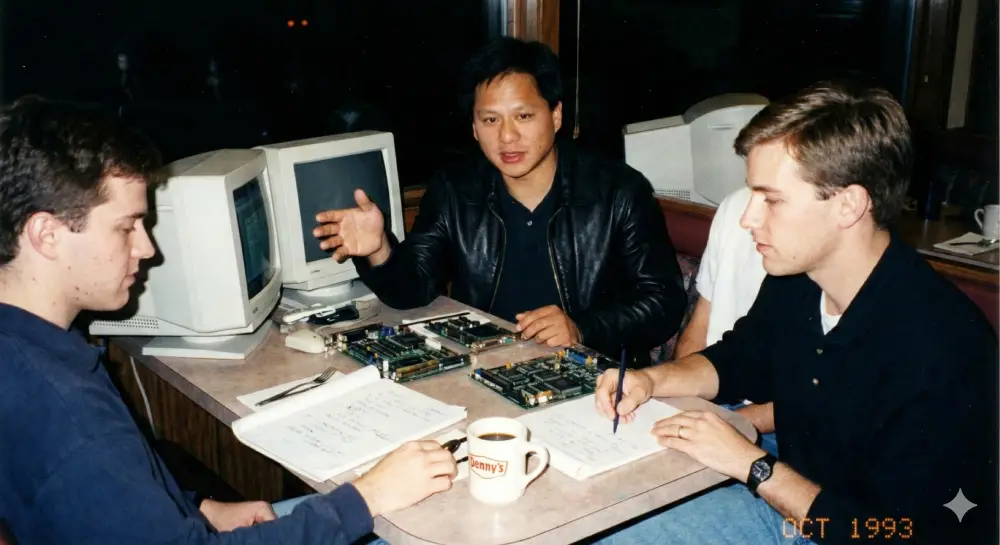
If you walk into a Denny’s diner in East San Jose today, you might just be ordering a Grand Slam breakfast. But in 1993, at a booth in the back, three engineers were plotting a revolution.
The booth wasn't glamorous. In fact, CEO Jensen Huang recalls that the front window had bullet holes in it. But the coffee was bottomless, and the rent was free.
Jensen Huang, Chris Malachowsky, and Curtis Priem weren't trying to build an AI superpower. They just wanted to solve a problem that no one else cared about: 3D Graphics.
The Problem: A World of 2D
In the early 90s, computers were boring. They were tools for spreadsheets and word processing. If you played a game, it was flat, pixelated, and slow.
The three founders had a wild theory: The PC would eventually become a gaming device.
They believed that if they could build a chip dedicated solely to complex math (graphics), they could unlock 3D worlds. Everyone told them it was a niche market. Everyone told them it was impossible.
They pooled $40,000 of their own money and started NVIDIA.
The Struggle: The First Failure (NV1)
Success was not instant. In fact, their first product was a disaster.
In 1995, they launched the NV1. It was a multimedia card that tried to do everything—audio, video, and graphics.
- The Result: It was expensive, proprietary, and incompatible with the new standard Microsoft was building (DirectX).
- The Fallout: Sales tanked. Developers hated it. The company was bleeding cash.
The Turning Point: 30 Days from Bankruptcy
By 1996, NVIDIA was on death’s door. They had run out of money. They had to lay off more than half their staff.
Jensen Huang had to make a decision that would terrify any CEO. He had enough money left for one last chip production run.
- If the chip worked, they survived.
- If the chip failed, the company was over.
He gathered the remaining team and told them the truth: "We are 30 days from going out of business."
They scrapped their old architecture. They worked nights, weekends, and holidays. They built a new chip called the RIVA 128. It was 400% faster than anything else on the market.
It worked. The RIVA 128 sold 1 million units in four months. NVIDIA was saved.
The Innovation: Inventing the "GPU"
Having survived death, NVIDIA didn't play it safe. In 1999, they released the GeForce 256.
Marketing called it the world’s first GPU (Graphics Processing Unit). It was the first chip to put the entire 3D pipeline on a single processor. It didn't just make games look better; it freed up the computer's CPU to do other tasks.
This was the moment NVIDIA stopped being a "chip company" and started being a "platform company."
The "Human" Lesson: The 30-Year Pivot
The most fascinating part of NVIDIA’s story isn't the hardware; it's the patience.
For 15 years, Wall Street screamed at Jensen Huang. They said, "Why are you investing billions into 'CUDA' (software for scientists)? You are a gaming company! Stick to video games!"
Jensen ignored them. He believed that one day, researchers would need GPUs to train massive supercomputers. He subsidized the AI industry for a decade before it made him a dime.
When ChatGPT launched in 2022, the world suddenly realized what Jensen had been building since 2006. He wasn't lucky. He was just early.
3 Lessons for Startup Founders
1. Embrace the "Zero-Billion Dollar" Market
When NVIDIA started, the market for 3D gaming chips was $0. Investors want to see "Total Addressable Market" (TAM). Sometimes, the best founders create the market themselves.
2. Radical Honesty
When the company was failing in 1996, Jensen didn't hide it. He told the team exactly how close they were to death. That urgency fueled the innovation that saved them.
3. Suffering is Necessary
Jensen Huang famously told Stanford students: "I wish upon you ample doses of pain and suffering." He believes that NVIDIA’s near-death experiences are what gave the company its resilience. Great companies aren't built in comfort; they are built in crisis.
FAQ: NVIDIA's History
Q: Did NVIDIA really start in a Denny's?
A: Yes. The founders didn't have an office, so they met at a Denny's in San Jose. They drank so much coffee that the waitress eventually kicked them out to the back booth.
Q: What does NVIDIA stand for?
A: The name comes from the Latin word "Invidia", which means Envy. The founders wanted their chip to be so fast that everyone else would be envious. The "N" stands for "Next Version."
Q: Was Jensen Huang always the CEO?
A: Yes. It is incredibly rare in Silicon Valley for a founder to remain CEO for over 30 years, taking a company from $0 to $3 Trillion.
Sources: Acquired Podcast, Jensen Huang Stanford Interview, NVIDIA Historical Archives.
Share this article